Exchango
ROLE(S)
UX Designers and Researchers
TIMELINE
Jan 2026 – May 2026
LOCATION
National University of Singapore
OVERVIEW
This case study highlights my work on the Safety and Logistics Vault, one of the core services within ExchangeGo, a super app designed to support exchange students in planning, coordinating, and navigating group travel. While other services in the ecosystem focus on planning, budgeting, and collaboration, the Vault addresses a different but equally critical dimension: safety and logistical clarity.
The Safety and Logistics Vault was designed as a centralized, secure space where users can store essential travel documents, access key trip information, and maintain awareness of their personal and group safety while abroad.
My work focused on translating high-stress, real-world travel scenarios into a system that prioritizes speed, clarity, and reliability. This case study explores how the Vault supports users when access to the right information matters most.
PROBLEM DEFINITION
🗒 Summary️
Exchange students frequently travel across multiple countries within short periods of time, often navigating unfamiliar environments without stable infrastructure or support systems. Despite the importance of safety and organization in these situations, critical information such as passports, visas, booking confirmations, and emergency contacts is typically scattered across screenshots, emails, and messaging apps.
While this fragmented system may function under normal conditions, it becomes unreliable in high-pressure situations. Users must search across platforms, reconstruct context, and rely on memory to access essential information. This delay introduces unnecessary stress and increases risk, particularly when immediate access is required.
👤 Target Users
University exchange students aged 18–26, travelling internationally with friends in small to large groups, often across unfamiliar destinations and environments.
‼️ Core Problem
There is no unified system that allows students to securely store, organize, and instantly access critical travel information. This leads to fragmented workflows, increased cognitive load, and unreliable access during high-stress situations.
🖌️ Design Opportunity
A centralized, secure Vault that integrates seamlessly into a super app ecosystem, enabling users to access essential documents, logistics, and safety features instantly while reducing friction across their travel experience.
🎯 Key Pain Points
📄 Fragmented Document Storage
Important files are scattered across multiple platforms, making them difficult to retrieve quickly.
🚨 Slow Access in Critical Moments
Users cannot access essential information fast enough when it is most needed.
📍 Lack of Safety Visibility
There is no clear way to monitor or understand group safety when traveling separately.
🧠 Cognitive Overload
Users must manage logistics, documents, and safety across multiple tools.
USER NEEDS AND RESEARCH
A consistent pattern emerged: users do not rely on a single system. Instead, important travel information is spread across email confirmations, screenshots, PDFs, and group chats. While this approach may feel flexible, it creates friction when users need to quickly retrieve specific details, especially in time-sensitive or stressful situations such as arriving at an airport, checking into accommodation, or navigating unfamiliar environments.
Another key insight was that users rarely prepare for emergencies in advance. Most assume they will search for information online if something goes wrong, rather than proactively storing emergency contacts or resources. This reactive behavior increases stress and delays response time during critical moments.
Group travel introduced additional complexity. Important logistics such as meeting points, booking details, and addresses are often buried in large group chats across platforms like WhatsApp, Instagram, and iMessage. This makes it difficult for users to quickly access shared information.
At the same time, location sharing is commonly used among close friends, particularly when groups split up or navigate unfamiliar areas at night. However, users expressed discomfort sharing their location with acquaintances, highlighting the need for privacy controls.
Overall, the research revealed a strong need for a centralized system that reduces information fragmentation, supports group coordination, and provides quick access to critical resources, ultimately making travel feel more organized and less stressful.
🎯 Key User Needs
⚡ Instant Retrieval in Real Contexts
Users need to access documents quickly while in motion; at airports, in taxis, or outside accommodations.
📂 Centralized Information Storage
Travel details such as flight numbers, booking confirmations, and addresses must be accessible in one place.
🚨 Preparedness Without Effort
Users do not proactively prepare emergency resources, so the system must make safety information easy to access by default.
📍 Controlled Location Sharing
Location sharing should be optional, customizable, and limited to trusted contacts.
👤 Personas
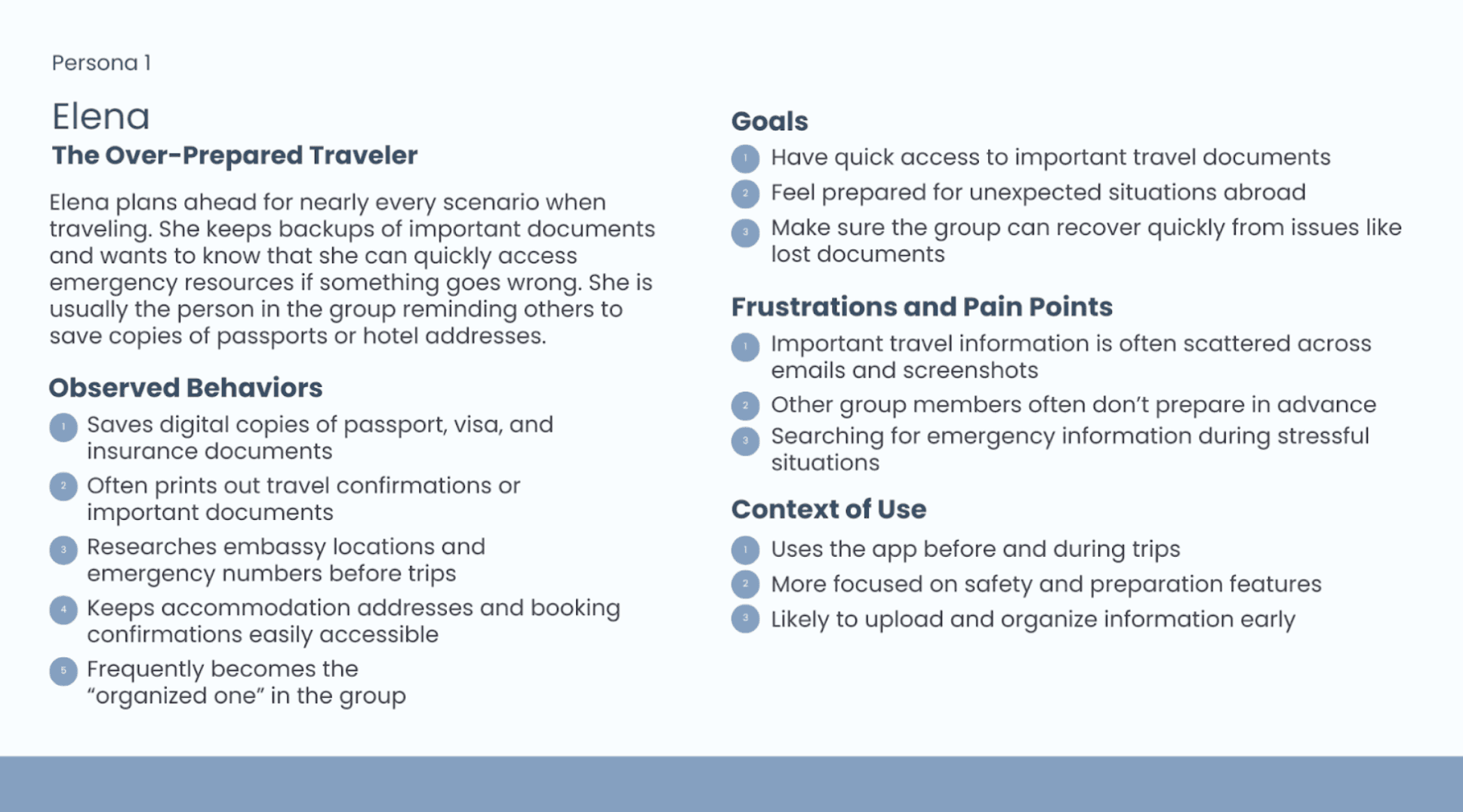
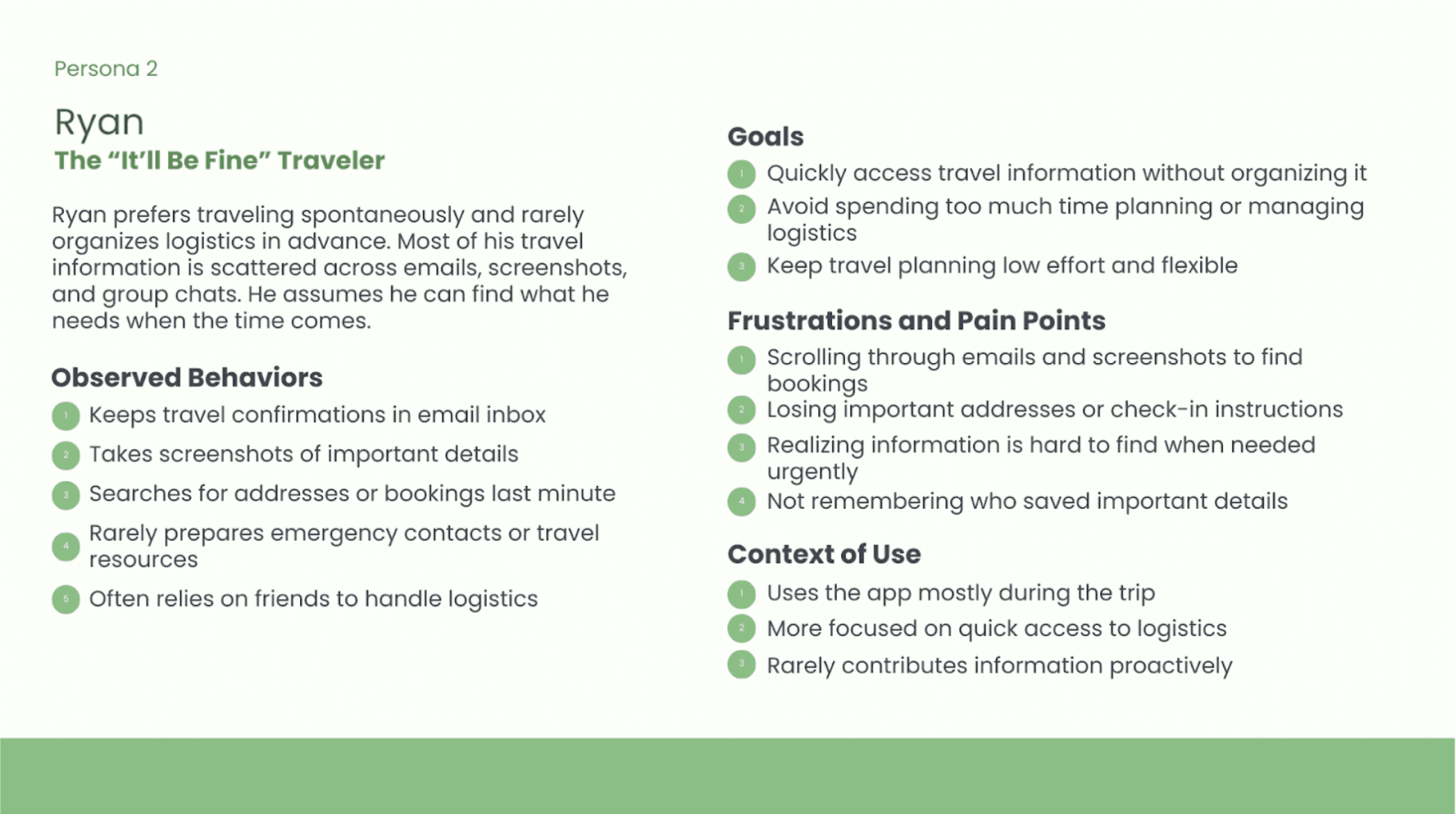
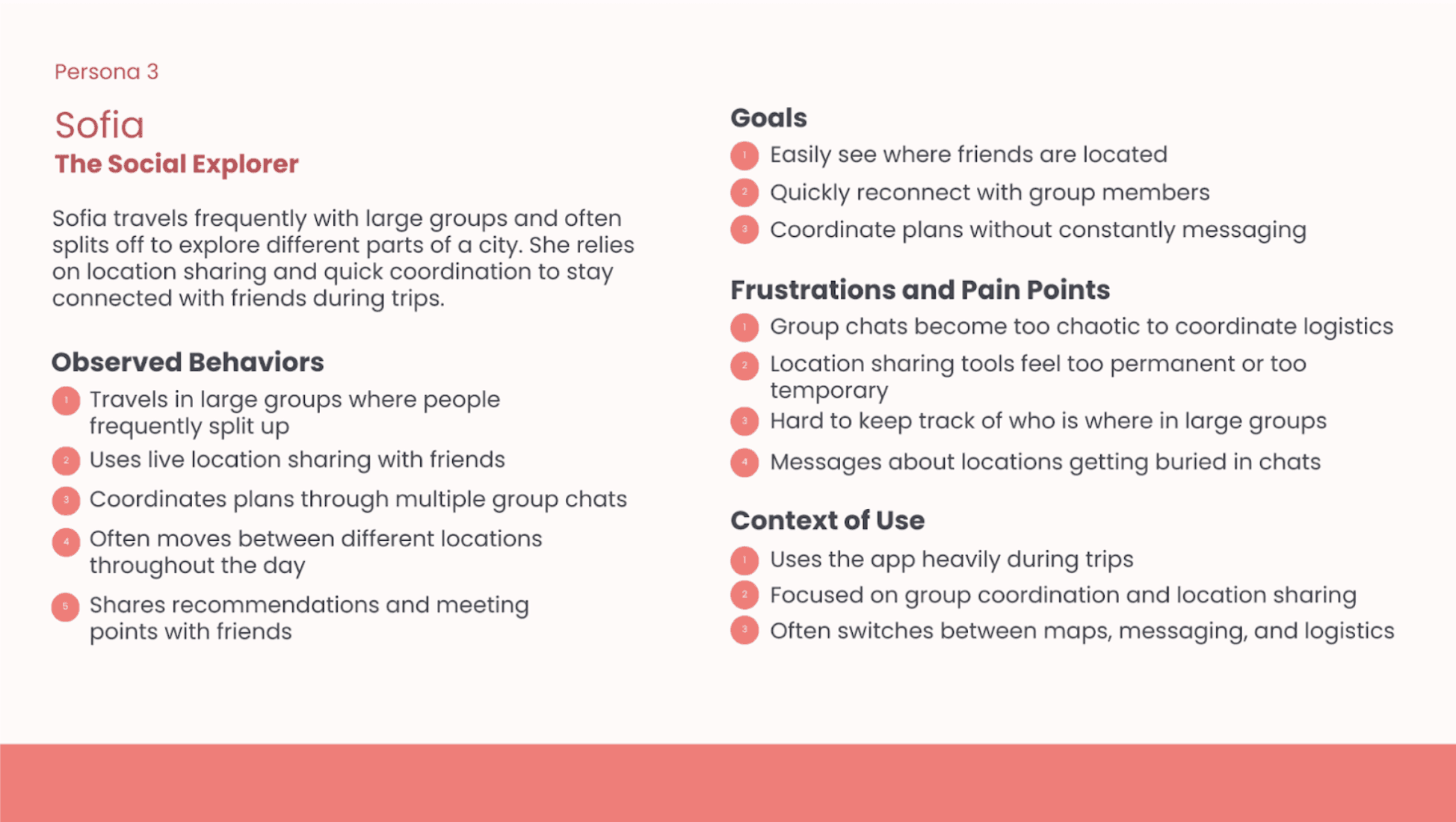
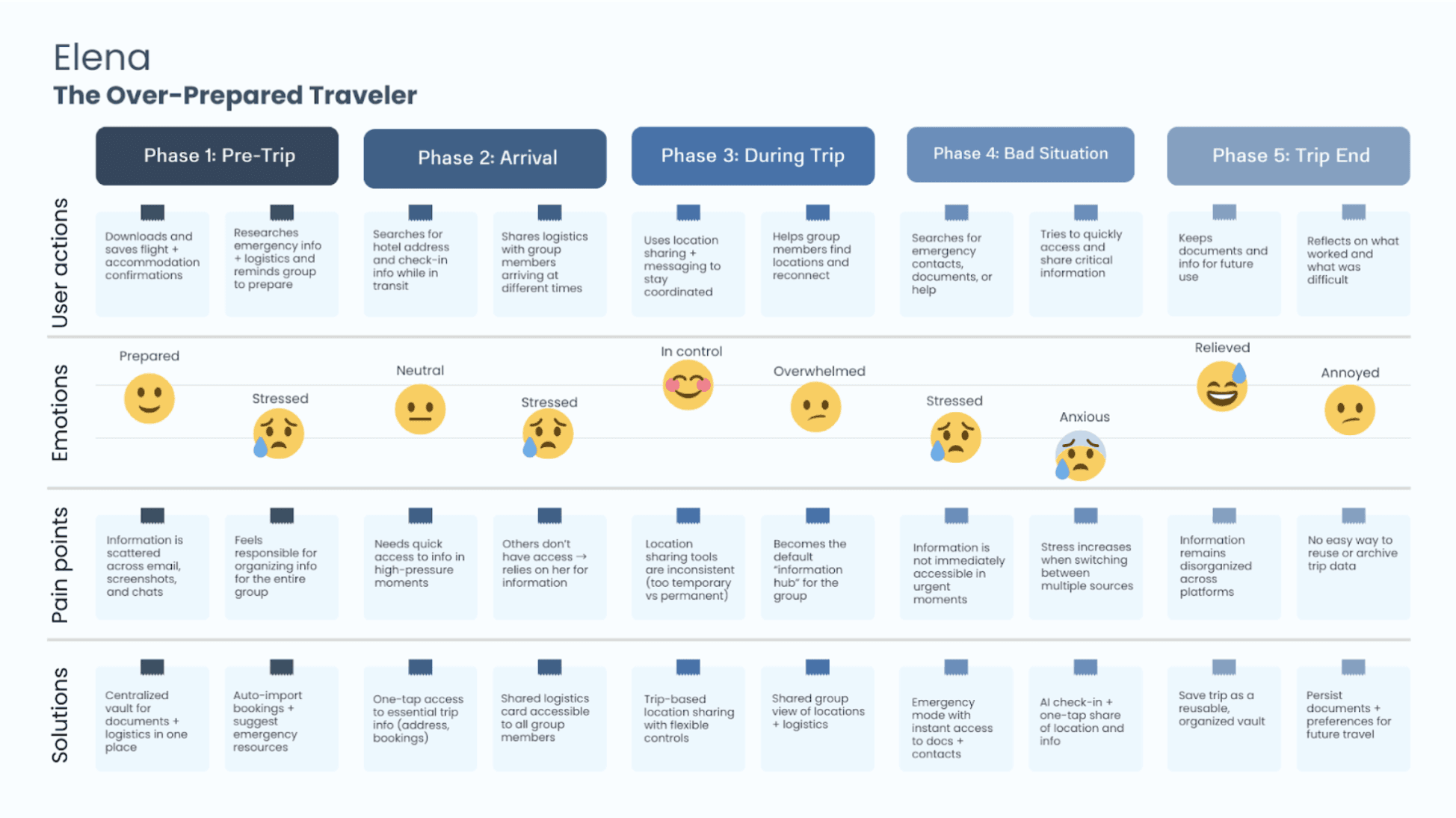
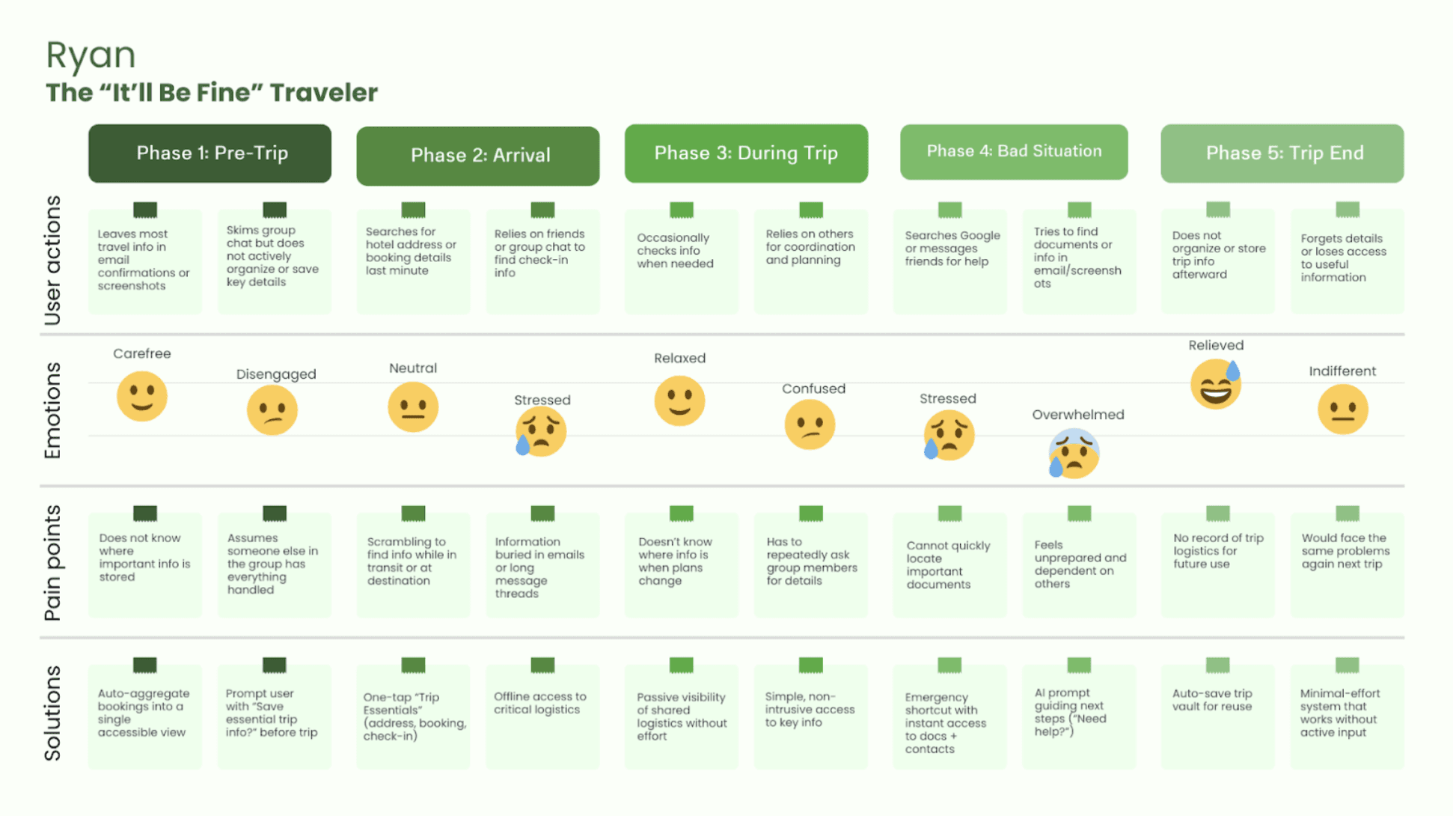
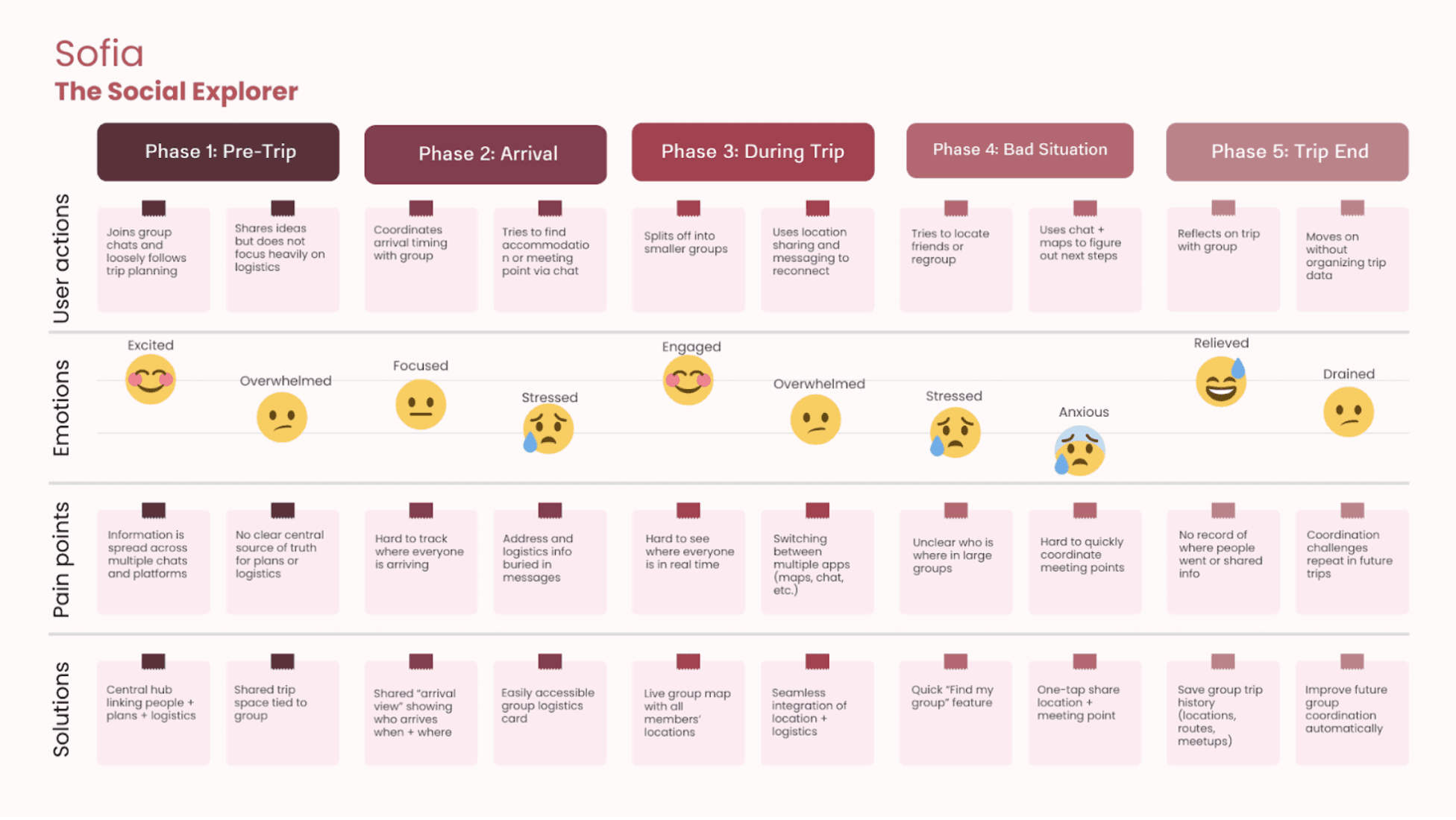
To better capture the range of behaviors observed in the research, I developed three personas representing distinct approaches to travel organization and safety.
Rather than focusing on demographics, these personas are defined by how users prepare for trips, manage information, and respond to uncertainty. Together, they highlight the need for a system that supports both proactive and reactive behaviors, as well as varying levels of trust and coordination within group travel.
🗺️ User Journeys
User journey maps were created to understand how safety and logistics challenges unfold across the full travel experience, from pre-trip preparation to in-the-moment navigation.
These journeys highlight key breakdowns in information access, coordination, and decision-making, particularly in situations where users are under time pressure or navigating unfamiliar environments. The insights from these journeys directly informed the prioritization of features within the Safety and Logistics Vault.
USER FLOWS & WIREFRAMES
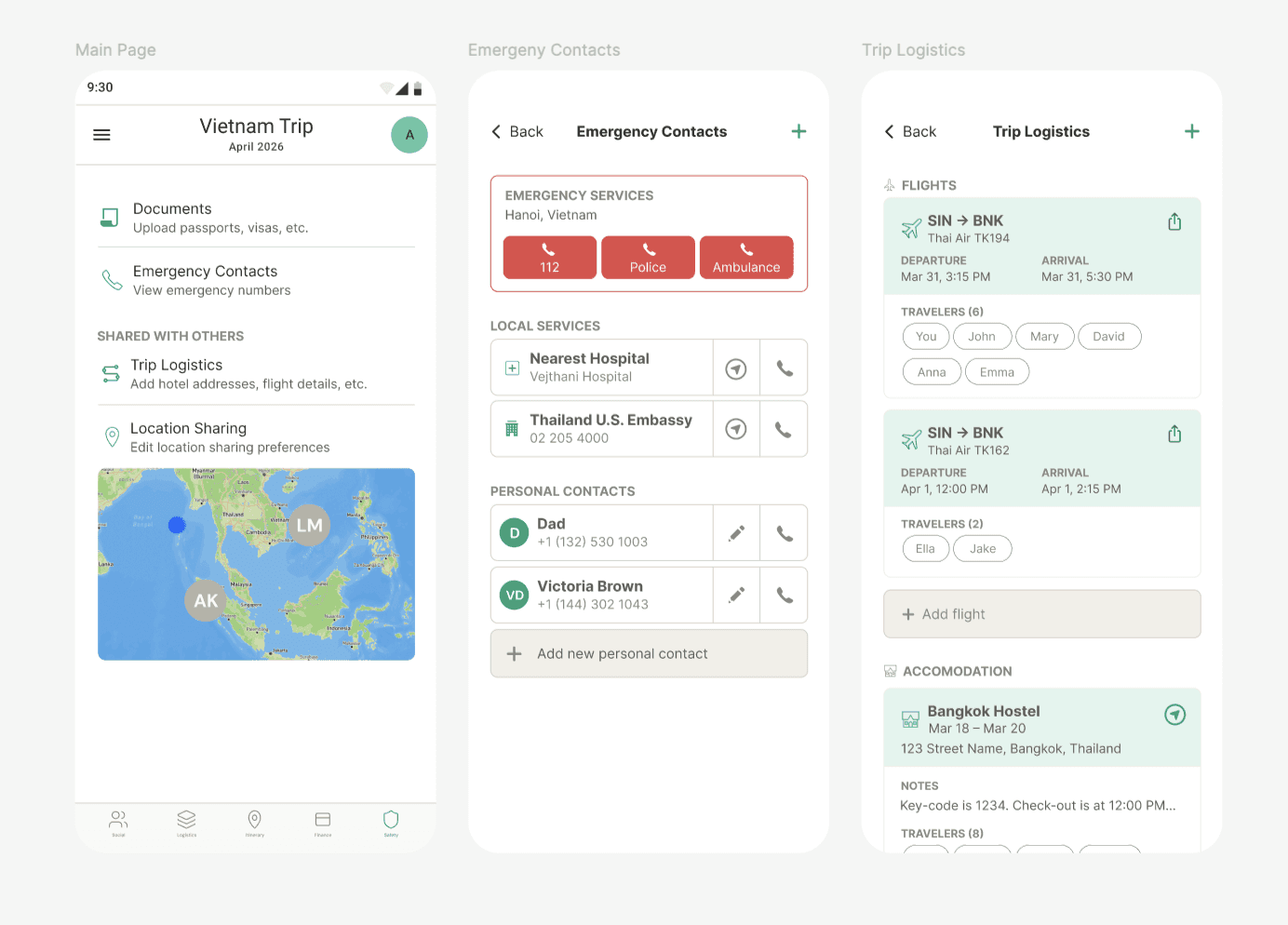
Based on research findings, I defined four core user tasks that capture the primary interactions within the Vault. These tasks focus on enabling users to store documents, access logistics, maintain safety awareness, and respond effectively in emergency situations.
🎯 Key User Tasks
📂 Secure Document Storage
Users upload and store important travel documents such as passports, visas, insurance, and boarding passes in a secure, easily accessible location.
🧾 Centralized Trip Logistics
Users access key details such as flight numbers, hotel addresses, and booking confirmations without searching across multiple platforms.
🚨 Emergency Contact Access
Users can quickly retrieve emergency contacts, embassy information, and personal support contacts while abroad.
📍 Live Location Sharing
Users share their location with selected contacts, with customizable privacy settings and time limits.
🔔 Safety Check-Ins
Users receive optional prompts to confirm their safety, helping maintain awareness in group travel scenarios.
👥 Group Logistics Visibility
Users access shared travel details such as meeting points and accommodations without relying on chat history.
🖌️ Wireframes
To further refine the design, I considered different user behaviors within travel groups, particularly how individuals engage with logistics and safety. Some users prefer to organize everything in advance, while others rely on more spontaneous decision-making. Additionally, group dynamics introduce complexity, as users may split up, rejoin, and navigate independently.
DESIGN RATIONALE
The design of the Safety and Logistics Vault is guided by three core principles: speed, clarity, and trust. Because safety-related interactions often occur under stress, the system prioritizes immediate access over feature depth.
Critical information is surfaced within one or two interactions, reducing the need for navigation. Security is implemented through lightweight authentication methods that protect user data without introducing friction. At the same time, safety features such as location sharing are designed to be transparent and user-controlled.
Integration is also a key component of the design. Rather than duplicating data, the Vault pulls relevant information from other services, ensuring consistency while reducing cognitive load.
🖋️ Design Principles
⚡ Speed Over Complexity
Minimize steps required to access critical information.
🔐 Security Without Friction
Protect sensitive data without slowing users down.
👁️ User-Controlled Safety
Ensure transparency and control over visibility.
🔗 Integration First
Leverage existing data across services instead of duplicating it.
SERVICE INTEGRATION
🏛️ Cross-Service Journeys
The Safety and Logistics Vault operates as a supporting layer within the ExchangeGo ecosystem. It connects with itinerary planning, financial tracking, and social coordination to provide context-aware safety and logistics information.
For example, accommodation bookings automatically populate within the Vault, while itinerary data provides location context for safety features. Financial receipts and confirmations can also be stored securely, ensuring that all important information is centralized.
🚪 Entry & Exit Points
The Vault is designed to be accessible both directly and contextually. Users can enter through the main navigation or through triggers such as booking confirmations or itinerary interactions.
Exiting the Vault returns users to the broader app environment, with all trip context preserved. This ensures continuity and reinforces the experience of a unified system.
HI-FI PROTOTYPE
The final prototype demonstrates how users interact with the Vault across all key tasks, including document storage, logistics access, location sharing, and emergency mode.
The interface emphasizes clarity and efficiency, ensuring that users can quickly locate and access critical information in any situation.
End-to-End Flow
The Safety & Logistics Vault supports users across the entire travel journey, from pre-trip preparation to in-the-moment navigation and emergency scenarios. A user may begin by uploading key documents before departure, access logistics details during transit, and rely on emergency contacts or location sharing in high-stress situations. Unlike traditional tools, the Vault ensures that critical information remains accessible at every stage without requiring users to reconstruct context.
FINAL THOUGHTS
💡 Learnings
This project emphasized the importance of designing for high-stakes scenarios rather than average use cases. Safety features may not be used frequently, but they must function reliably when needed.
Balancing security with accessibility required careful consideration of user context, while integration across services highlighted the importance of cohesive system design. Ultimately, the Vault demonstrates how thoughtful interaction design can reduce friction and increase confidence in complex, real-world situations.
AI Usage
AI tools were used throughout the design process as a form of quality control to validate that design decisions remained aligned with user research. After synthesizing findings from interviews, surveys, and behavioral observations, I used AI to help consolidate patterns across data points and identify recurring themes.
No AI was used in the ideation and design process itself.